


An Ascetic Approach to Married Life

It all
began with our forefathers, Adam and Eve. They received a commandment in
paradise not to taste of the tree of the knowledge of good and evil (cf. 2:17).
The commandment not to “taste of this or that” is quite well known to any
Orthodox Christian. This is the commandment to fast—the most ancient, beginning
factor of family life.
As we
know, the first family was tempted by satan, the forefather of all evil. That
envier could not calmly watch their happy life. Adam and Eve broke the
commandment of not eating. The Lord called them to account. Then they tried to
place their own blame on someone else, as if they were not guilty at all. Not only
that, but Adam blamed his wife, who, as he emphasized, he had received from
God. That is how the fall into sin happened, and people did not repent of what
they had done. The Lord deprived them of paradise, and gave them a penance.

Let us
briefly recall the words of that penance from God. The wife was told: I will
greatly multiply thy sorrow and thy conception; in sorrow thou shalt bring
forth children; and thy desire shall be to thy husband, and he shall rule over
thee (Gen. 3:16). To the husband, the Lord said, In the sweat of thy face shalt
thou eat bread, till thou return unto the ground; for out of it wast thou
taken: for dust thou art, and unto dust shalt thou return (Gen. 3:19).
Sorrows
entered the life of human beings. Steadfast endurance of sorrows is an
important part of asceticism.
Our task
is to remember that sorrows came as the result of sins. We have to bear them
without anger, without murmuring against God. It is painful to be sick, painful
to die (to return to dust). This feeling of sorrow must be melted in
repentance. Then those oppressive thoughts of death can become exalted; they
can become the remembrance of death.
After the
fall, Adam not only had to work—he had to work hard. That is how it was in his
life, and that is how it is in ours. Every man has to think about how he will
feed himself and his family. He must at times do work that is both hard and
dreary.
Archimandrite
Sergei (Shevich) often found that his parishioners were sometimes weighed down
by the work that they had to do every day. Fr. Sergei pointed out to them that
work for a married person is the same as an obedience for a monk. As we know,
monks do not choose their obedience according to their own taste. The monastic
does whatever he has been given the blessing to do. Be it unattractive and
boring, obedience nevertheless accustoms a monk to cutting off his own will,
and, accordingly, to do the will of God. For Adam and his descendants, God’s
will is to live after the fall under non-paradisal conditions, not to complain
about this, and to repent. They should also hope in God, Who leads people to
His Kingdom.
For a
woman, a time of particular trial is pregnancy. She has to think more about her
child than about herself, to pay special attention to her own health, keep to a
regime, and, perhaps leave a lucrative job for the sake of her child—to give up
her planned career growth. This is her ascesis of self-restraint. This is not
to mention the pain of childbirth, and the uninterrupted care and fuss over the
newborn.

The
infant’s parents have to deny themselves basic rest, and are sleep deprived.
They worry about their little one, and pray during anxious times for their
child’s well-being: “Lord, You know all things, and Your love is perfect. Take
the soul of (name), and do what I wish to do, but cannot.”
And if
the child was born handicapped… What faith in God’s Providence is needed in
order to bear that heavy cross!
Almost
immediately after the birth of a child a great labor begins—raising the child.
Even if we take the non-religious side of the matter, we know that we cannot
get by without God’s help. Fr. Gleb Kaleda was right when he insisted that the
foundation of upbringing and education is placed in the family, while school
and college serve only to supplement what has been done in the family. The
supplement is important, but it only enhances the main thing.
Often we
see that in school children are required to memorize information, but taught
very little about how to think for themselves. Even less are they taught
morals. What should be done in this case? The family can make up for the
inadequacies of an impersonal and commercial education and upbringing—that is
if the parents seriously take care of their child, and not only of his physical
needs, but also his emotional needs. All this takes many patient years.
Parents
are also called to care for the spiritual needs of their child. It would be good
to teach the small child to pray (in the majority of schools and universities,
he will not be taught to pray to God). But to do this the parents themselves
need to know how to pray attentively, to understand the language of prayer, and
to accessibly explain the essence of the church services to their child. As the
child grows to school age, he should be prepared for his first confession. How
can parents explain to him what sin is, and why he needs to tell the priest
about his sins. Here one’s personal example is needed, the parents’ personal
efforts on the spiritual path. If the mother takes the child to Communion but
does not herself approach the chalice or go to confession, if the father goes
only rarely to church, then it will be pretty hard to convince the child that
all of us need the Church Sacraments.

In the
home where there is no understanding of breakfast, lunch, and dinner, where
everyone eats whenever they want (and even when they don’t want), it is hard
for a child to assimilate the concept of fasting. “You can’t lead children to
fasting if they are allowed to eat whenever they like, if they are allowed to
run through the house with a piece of bread and sausage or a biscuit.
Regularity of food intake is, if you will, the beginning of Christian ascesis…
Through prayer before a meal a person learns to begin everything with prayer.
If there are visitors in the house and it is not possible to pray in front of
them, it is important that all members of the family cross themselves if only
mentally… It is necessary to cultivate both the obvious and secret forms of
everyday Christian life,” Fr. Gleb Kaleda used to say. Domestic life can become
a good support for spiritual life, but it can also become a profound
obstruction.
***
The
passion of self-love stands out as the family’s worst enemy. Egoism is a
dangerous enemy.
When a
married couple does not want to yield to each other in anything, each morbidly
guarding his or her own pride; if each continually counts the times that he or
she did something for the family, then that family will little-by-little fall
apart. If couples easily give place to anger, argue over trifles, and cannot
peacefully live with each other’s close relatives, then they themselves feel
wretched, and their children absorb their bad example. How hard it is to bring
up children by our own example!
True
ascetic labor is required of parents in order not to consign their children to
the education of television, internet groups, or the streets. That is on the
one hand; on the other hand, children must not be tortured with excess care.
After all, super-care leads to infantilism, introversion, and sometimes even
rebellion against parents.
The
family is a school of love.
All
Christian ascesis is directed toward acquiring love. Christ the Savior boiled
down all the commandments to two: love of God and love of neighbor. St.
Theophan the Recluse compares love to fire: if we do not throw logs on the fire
it will go out; if love between husband and wife is not stoked with deeds of
love, it will eventually die out. And what are these deeds of love? They are
the deeds of basic care one for the other, obvious and unobvious signs of
attention. They are the ability during arguments to overcome outbreaks of anger
and to be the first to come and make peace. They are the ability to take your
egotistical inclinations in hand, to correct your actions, always thinking to
yourself “I am not the only one.”
Fr. Gleb Kaleda wrote very well and in detail
in his book about the ascetical life in a family, The House Church. His book is
firmly supported by Orthodox tradition that has gone down through the ages, but
he does not close his eyes on the particulars of Christian life in our complex
times.
By Deacon Pavel Serzhantov
Source: http://orthochristian.com/64414.html

What Can Separate us From the Love of Christ?

I grew up
in Binghamton, New York, in a parish where the church was the center of my
life. I served as an altar boy and went to the Church School, which was huge!
We had a teenage Bible Study group; the church had a basketball team (which I
was not very good at). I ran the parish library. We had altar boy practice
every Saturday – we sang the Liturgy and learned about serving the services –
there were as many as 36 altar boys at a time! So, almost every weekend, I was
in church for Saturday Liturgy, Vespers, Matins, and Sunday Liturgy… plus holy
days, baptisms, weddings, funerals and everything else that came with life in
the Church.
 After
high school, I went to college nearby and lived at home. I never had the
problem of wondering, “What do I do when I’m on my own?” I worked out my class
schedule so I could be at the Liturgy during the week when there was one.
Church was the place to be.
After
high school, I went to college nearby and lived at home. I never had the
problem of wondering, “What do I do when I’m on my own?” I worked out my class
schedule so I could be at the Liturgy during the week when there was one.
Church was the place to be.
I loved
being in church, and I loved what I was doing in church – especially serving in
the Altar and learning about the Faith. So it was only logical for me to want
to become an imitation of my parish priest, Fr. Stephen Dutko of blessed
memory, so that I could have, and give, that same kind of experience. I wanted
to be like Father Stephen.
And so I
did. I went to seminary right after college. I got married and ordained at 22
years old. I was assigned to my first parish, Saints Peter and Paul Church in
Homer City, PA, and I was raring to go.
Then it
all changed. After 29 days of marriage, my wife and I were in a car accident.
She was killed instantly. I was in the hospital – in a coma. I came out months
later, confused and bitter, guilt ridden and doubting. I was feeling all those
kinds of things that a person would feel in that horrific situation. Why did
God let this happen? It had to be somebody’s fault. All the confusion, all the
anger, definitely made me think about not being a priest anymore.
However,
I couldn’t conceive of not serving at the Altar. I could not conceive of living
my life outside of that experience that I had had all those years. I just could
not imagine that.
So,
rather than walk away from the Church, I did what I really needed to do – and
what I have counseled so many people, of all ages from the youngest to the
oldest, to do when we have these terrible, tragic experiences. And that is to
draw closer to Christ in the face of pain and agony and loss. When I did that,
it was not just an inner, “me and Jesus” kind of experience. The Lord came to
me, and began to heal me through the faces, the words, the embraces, the love
of His people: the Church.

My
spiritual father was one of them. He was tough on me. He told me, “Your faith
just has to kick in.” One of the questions I raised was, “Where was God when
all this happened?” And he said, “He was in the same place the day that Debbie
died that He was on Great and Holy Friday, when His Son died.” He told me that
even though that particular Tuesday when we had the accident might have been a
Good Friday to me… still, Good Friday is not the end of the story… Pascha is.
He reminded me that Christ triumphed over death – and I had to believe that my
wife was a sharer in that victory and in the Resurrection.
So, I
never left the Church. I never walked away from the priesthood. My first parish
as a priest became a replica of what I had experienced in my home parish as a
young person… and those people who I served as a young widowed priest helped me
nurse back to spiritual health – as well as me helping them in their dark
moments and in their difficulties. It wasn’t just me, as their priest, taking
care of them. Guided by God, as His family, we cared for each other.
A famous
Christian writer named Tertullian, who lived less than 200 years after Jesus,
wrote that “A Christian alone is no Christian.” He meant that no one is saved
alone… it takes the Church to save a soul. Whenever I look back on that
incredibly painful time in my life, I am more and more deeply convinced that I
never would have survived – not spiritually, and maybe not literally – without
the Church. I do not mean just the Church as a building, although that is the
place where we meet and pray and even play together. I mean, the Church as a
community; the constant presence of the people of God – my spiritual father, my
parishioners, my brother priests and their families, with all of the guidance,
the prayers and the love that they have to share.
 Even
though my hope for you who read this is that you never have to go through what
I went through, I pray that somehow, whenever you do experience difficulties,
doubts, and obstacles, by God’s grace, your faith will “kick in.” I pray that
you will seek, and find, the healing and the love that Our Lord offers us in
the faces, the embraces, and the prayers of others — the love of Christ Jesus,
shown within the community of His Church.
Even
though my hope for you who read this is that you never have to go through what
I went through, I pray that somehow, whenever you do experience difficulties,
doubts, and obstacles, by God’s grace, your faith will “kick in.” I pray that
you will seek, and find, the healing and the love that Our Lord offers us in
the faces, the embraces, and the prayers of others — the love of Christ Jesus,
shown within the community of His Church.
One of my
favorite quotes in the Bible is from St. Paul’s Epistle to the Romans, in which
he asks the question, “What can separate us from the love of Christ?” (Rom.
8:35). And he answers that neither height nor depth… nor life nor death…
nothing can separate us from the love of God which is in Christ Jesus our Lord.
Thanks to the Church, I am living proof that this is true.
By Bishop Michael (Dahulich) of New York and New
Jersey
Source: http://www.pravmir.com/what-can-separate-us-from-the-love-of-christ/

Handpainted and Emboirdered Icons of Holy Apostle and Evangelist Matthew


St. Nikolai Velimirovich about the Prayer of the Publican

Here is
what the Pharisee says: “God, I thank Thee that I am not as other men are.” He
is not, in fact, thanking God for this, acknowledging that it is God’s doing
that he is not as other men. No; the words: “God, I thank Thee … ” are nothing
more than an exclamation, a flattering approach to God so that God will listen
to his boast. For, from all that he says, he is not thanking God for anything;
on the contrary, he is blaspheming against God by blaspheming against the rest of
God’s creation.
 He is thanking God for nothing; everything that he says about
himself is expressed as his own doing, achieved without God’s help. He will not
say that he is not an extortioner, an unjust man, an adulterer or a
tax-collector because God has preserved him from this by His power and His
mercy. In no way; but only because he is what he is in his own assessment: a
man of such exceptional type and worth that he has no peer in the whole
world.Book St Nikolai Homilies
He is thanking God for nothing; everything that he says about
himself is expressed as his own doing, achieved without God’s help. He will not
say that he is not an extortioner, an unjust man, an adulterer or a
tax-collector because God has preserved him from this by His power and His
mercy. In no way; but only because he is what he is in his own assessment: a
man of such exceptional type and worth that he has no peer in the whole
world.Book St Nikolai Homilies
From “Sunday of the Pharisee and the Publican:
The
Gospel on True and False Prayer,” Homilies Volume 1

"They Are Waiting for Someone to Visit Them": Sisters of St.Elisabeth Convent Caring for the Patients of the Mental Health Hospital

A Lecture by Sister Irina, who serves as the sister of mercy in the mental Health Hospital in Minsk:
The history of the convent started with the social work in the hospital. One of the current nuns was a nurse there and saw how much people suffered there. Surely, any hospital is a place of sorrow.
The history of the convent started with the social work in the hospital. One of the current nuns was a nurse there and saw how much people suffered there. Surely, any hospital is a place of sorrow.
Our patients
are not necessarily people from socially disadvantaged environment or
dysfunctional families. Imagine a person who was successful, but something
happened in his life and he got to the hospital and was diagnosed with schizophrenia.
People who get there for treatment suffer not only from their disease itself,
but also from the understanding of their diagnosis. After you leave the hospital,
it is quite difficult to find a job. Perhaps, only the convent can accept these
people without any problems. People with such illnesses are often misunderstood in everyday society, and this makes
people suffer much more themselves. They begin to ask questions. Why me? Why do other people live a normal life, while I have to spend my life here?
I have visited
a woman who used to be a successful and beautiful person once but then she got
to the mental health hospital. She was desperate. We have a proverb saying that if
you feel bad you should look at someone who feels much worse that you. I tried
to use the example of parents whose child died from cancer. I said, “Look at
these unhappy people. They have been fighting with the disease for years but
still they lost their child. They do not scorn God, they thank Him. You are
young and you will get help here. Then you will receive supportive treatment and
your life will get better. Of course something will change, but you will leave this
place”. She replied, “Of course it is much easier for them to cope with their
sorrow. They do not feel shame for their child’s death. This is not disgraceful”.

Our main task
as the sisters of mercy is to prepare our patients for confession, Holy Communion,
tell them about God, communicate with them and comfort them. We tell them about
God as the source of life and joy.
How do our visits
look like? We come, greet the personnel and the patients, we anoint all and anyone who wants with the holy oil, pray together and then just talk. It is up to us
to decide what to discuss with these people. Usually, I read them the Holy
Gospel and then we discuss what I have read.
Many people ask
why we are not afraid to go there. When I began to visit the patients, I was told
to be careful, to make sure no one stands behind me, to take off my glasses. I
had a wonderful experience after which I forget about any fear. Once I came to
the department and saw that the woman I had recently visited was lying tied to
the bed. She asked me to come to her, but it was forbidden. I talked to all my
patients and we read the Gospel together. Suddenly I heard a noise and saw that
woman running to me across the hall. I leaned to the wall, but she run right at
me. She reached me and throw herself at me and said, “Please, save me”.
Today there are
32 working departments in the hospital. We visit 30 of them, 2-3 sisters for
each department. There are 15 mental health departments, 2 departments for
people with alcohol addiction, departments for dangerous criminals, for men and
women. There are also departments for children, 3 departments for elderly
people who lie there helplessly because of their age and and various illnesses. There
was a case when Fr. Andrew, our spiritual father, came to that department on
Easter to serve a moleben. An elderly woman went towards him. She did not
understand at all why and where she was going. Her condition was quite
difficult. He asked her, “How do you feel? How are you?” And she answered, “Dear
son, everything is great”.

There are
departments for people with depression. A person has no desire for anything. He
cannot eat or drink, he just does not care for anything. He lies on his bed and
looks at the wall. One of our sisters visited a woman who was in similar condition.
She always lied on her bed against the wall and never spoke. The sister came,
greeted the woman, put a caramel near her bed and left the room. It went like
that for some time, and then the woman was checked out of the hospital. Much
later the sister told us that she was going on the bus, when a woman came to her
and asked, “Don’t you recognize me? Your caramel has saved me”. Such a simple
gesture, a simple candy helped a person to cope with depression. Of course, the
treatment helped to recover, but the candy matters too.
We persuade our
patients to accept their treatment. There are certain diseases, which need
special treatment. Such medications can block certain parts of the brain, and
this can look quite unpleasant: the eyes roll, some drool… People are afraid that they will remain in such a state forever. This is why we tell the patients
they should cooperate with the doctors. We tell them about human dignity and
that God loves everyone.
We had the
cases when people were baptized right in the department. One of the patients of
the narcological department completely changed his life and became a priest. I
think that our communication, our sisters and our convent become a great
support. While we believe, that people and their prayers support us.
We really needed to build the church in honor of St. John of Shanghai so that the liturgy for
the sick can be served there. People will come there to pray and rest. On the
ground floor of the church there will be a place where we can organize meetings with people who have been discharged from the mental health hospital. We will
teach such people handiwork.
Many people do
not understand the reason why we visit the hospital. Are you paid a salary? No.
Don’t you have a family? Are you unhappy? No. Don’t you have anything to do at
home? We have. Are you jobless? No, we are employed. We come to these people
because they are our brothers and sisters. And we need to visit them.
St. Elisabeth Convent
November 27, 2017

Subscribe to:
Posts
(
Atom
)

About Our Blog
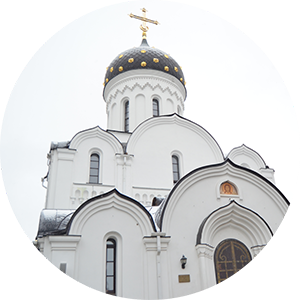
Welcome to the official blog of the Catalogue of St.Elisabeth Convent! The blog includes recent ministry updates of the convent, sermons, icons, personal stories and everything related to Orthodox Christianity. Join our Catalog of Good Deeds and become part of the ministry of St.Elisabeth Convent! #CatalogOfGoodDeeds
Most Popular Posts


Partners

